SHOREKALC / Q8 VERIFICATION
Benchmark 3: PLAXIS tied-back excavation
Recorded Q8 comparison: 8 October 2026. A dry, 15 m deep excavation supported by two rows of prestressed anchors, using drained Mohr-Coulomb soil materials.
Published reference
The Seequent PLAXIS 2D 2023.1 worked example describes geometry, soil parameters, interfaces, anchors and the construction sequence. Section 3.1 gives approximate final moment, anchor-force and excavation-floor-heave checkpoints.
Final-stage comparison
| Case | Peak moment (kNm/m) | Wall movement (mm) | Upper / lower anchor (kN) | Floor heave (mm) |
|---|---|---|---|---|
| Q8, 743 nodes | 318.97 | 3.53 | 342.58 / 341.01 | 58.36 |
| Q8, 862 nodes | 314.99 | 3.51 | 342.13 / 340.63 | 58.19 |
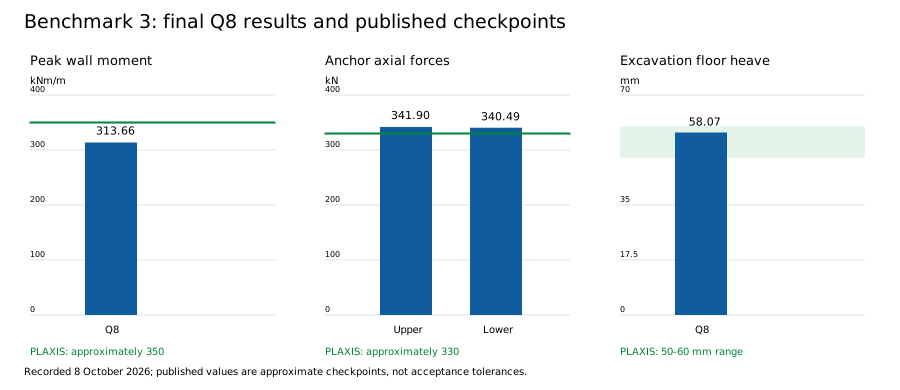
| Q8, 1065 nodes | 313.66 | 3.66 | 341.90 / 340.49 | 58.07 |
| Published PLAXIS | Approximately 350 | No scalar checkpoint supplied | Approximately 330 each | 50-60 |
Interpretation and scope
The finest completed Q8 case gives 313.66 kNm/m peak moment, approximately 10.38% below the published checkpoint. Anchor forces are approximately 3.61% and 3.18% above 330 kN; floor heave is within the published range. All three runs completed initial equilibrium and five construction phases.
Moment changes by 0.42% between the last two refinements, while wall movement changes by 4.41%. This limited study does not establish mesh independence.
Recorded modelling differences include fixed remote anchor ends, omitted grout-body extension and moving-soil coupling, omitted wall self-weight in this run, and different beam and contact formulations. The lower anchor force remains slightly below the upper, unlike the published result. No physical stiffness or strength was fitted to the reference.